Port of Subic 2019 | SubicNewsLink

Showing posts with label Port of Subic 2019. Show all posts

28 December 2019

Asia’s biggest cruise ship makes maiden call in Subic Freeport

MV Spectrum of the Seas, known as the largest cruise ship operating in Asia today, made its maiden port call here on Friday, capping Subic Bay Freeport’s stellar performance this year as the region’s emerging cruise ship destination.

Subic Bay Metropolitan Authority (SBMA) Chairman and Administrator Wilma T. Eisma who personally welcomed the disembarking passengers said that almost 5,000 foreign tourists arrived on the ship.


“More than 20 tourist buses were fielded for our guests, who would be touring various attractions in Subic and in the nearby communities,” Eisma pointed out.

“This is great news for the SBMA, which has been marketing Subic as a must-see destination for cruise liners, and this is also great news for tourism stakeholders in Central Luzon,” she added.

The MV Spectrum of the Seas is the first Quantum-Ultra-class cruise ship built for Royal Caribbean International, the world’s largest cruise line in terms of revenue and second largest by passenger count.

The ship is the biggest and the most expensive cruise ship to sail in Asia and features Royal Caribbean’s first private enclave for suite guests, new stateroom categories and innovative dining concepts on top of amenities like outdoor and indoor pools, body and mind spa, fitness centre, rock-climbing wall, sports court, Splash-away bay, and an outdoor movie screen.


Spectrum of the Seas can accommodate 5,622 passengers, as well as 1,551 crew members.

Eisma said that the arrival of Royal Caribbean’s top cruise liner marks the start of the second phase in Subic’s cruise ship tourism program.

"Beginning January next year, we shall be seeing more and bigger cruise ships in Subic. The MS Spectrum of the Seas will come back for another visit on January 20, to be followed its sister ship MS Quantum of the Seas, another behemoth that will arrive here on February 28,” she said.

Eisma added that with the arrival of bigger ships, the SBMA expects to receive bigger financial windfall for Subic and the neighboring areas of Olongapo City, Zambales, Bataan and Pampanga.

According to SBMA records, Subic received a total of 19 cruise ship in 2018, which marked the start of the agency’s cruise tourism program. The arrivals yielded a total of 38,205 visitors, and earned the SBMA Seaport Department P8.4 million in direct revenue.

This year, the 15 cruise ship arrivals from January to October generated 38,985 visitors and an income of P8.07 million for the SBMA Seaport.

Eisma said the actual income earned by all the tourism players in Subic and neighboring communities would be bigger since this would include money earned by tour buses and taxis, entertainment groups, restaurants and shops, tiangge vendors, theme parks and resorts, as well as malls in Subic and nearby areas. (MPD-SBMA)

PHOTOS:

[1] MS Spectrum of the Seas, the biggest cruise liner operating in Asia, docks at the Alava Wharf in the Subic Bay Freeport on Friday, Dec. 27.

[2-3] SBMA Chairman and Administrator Wilma T. Eisma personally welcomes cruise ship passengers with lei, as SBMA employees cheer on the disembarking passengers.
18 December 2019

More and bigger cruise ships expected in Subic next year

More cruise ships are expected to arrive in this premier trade and tourism port next year, as the Subic Bay Metropolitan Authority (SBMA) continues to upgrade maritime facilities to increase cruise tourism traffic.

SBMA Chairman and Administrator Wilma T. Eisma said the Subic agency has already listed 38 confirmed cruise ship arrivals and two tentative bookings next year.


On top of that, four confirmed arrivals and one tentative booking have been posted for 2021, she said.

“Beginning January next year, we shall be seeing more and bigger cruise ships in Subic. This includes MS Spectrum of the Seas, which will dock here on December 27 and then come back for another visit on January 20,” Eisma said.

“Then on February 28, its sister ship, the MS Quantum of the Seas, will be arriving in Subic,” she added.

The two ships, which are owned and operated by Royal Caribbean International (RCI), the world’s largest cruise line by revenue and second largest by passenger counts, are among the world’s largest cruise ships in operation today.


MS Spectrum of the Seas is set to arrive with 4,819 passengers, while MS Quantum of the Seas will bring in 4,905 passengers.

“These arrivals will also serve to provide additional income to the Subic community, as well as neighboring areas that cruise passengers visit upon arrival here,” Eisma said.

According to SBMA records, the 19 cruise ship visits in 2018 yielded a total of 38,205 visitors and direct revenue of P8.4 million for the SBMA Seaport Department.

This year, the 15 cruise ship arrivals from January to October generated 38,985 visitors and an income of P8.07 million for SBMA Seaport.

Eisma pointed out that the actual income earned by all the tourism players in Subic and neighboring communities would be bigger since this would include money earned by tour buses and taxis, entertainment groups, restaurants and shops, tiangge vendors, theme parks and resorts, as well as malls in Subic and nearby areas.

Eisma said the SBMA aims to generate more cruise ship traffic by retrofitting the Alava, Bravo, and Rivera wharves in the Subic Freeport to accommodate more arrivals.

“We’re also upgrading the Subic Bay International Airport to attract passengers who may opt for the sea-air connection available in Subic,” she said.

Eisma said that another measure the SBMA would look into is the issuance of implementing rules and regulations for Executive Order 72, which governs the admission and stay of foreign nationals in Subic as temporary visitors.

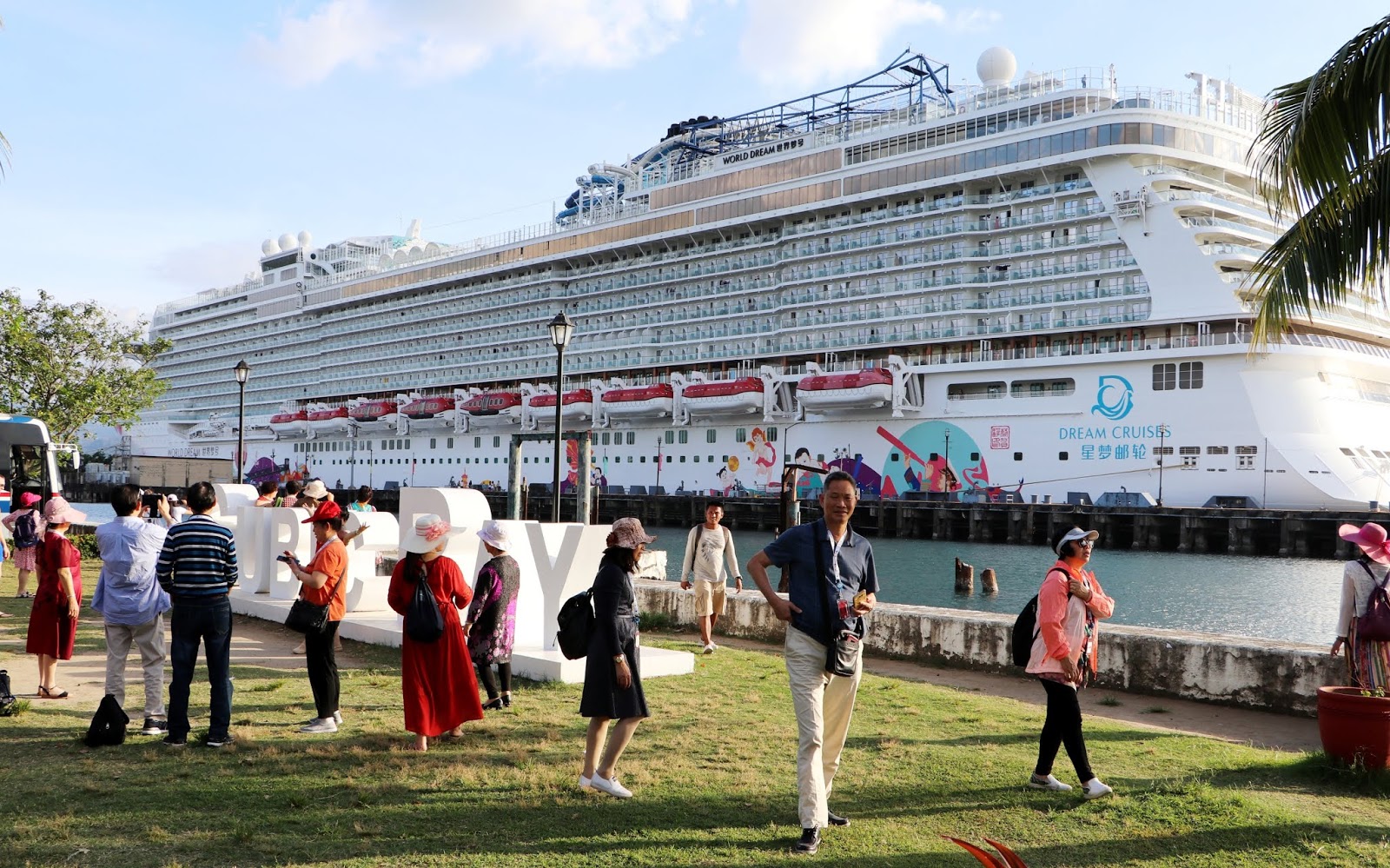
The latest cruise ship to arrive in Subic was MS World Dream, which arrived on December 11.

World Dream, which has a capacity of 3,376 passengers, was designed for the Asian cruise market and is now operated by the Dream Cruises line of the global entertainment and leisure firm Genting Hong Kong. (MPD-SBMA)

PHOTOS:

Passengers of World Dream buy local food products and souvenir shirts at kiosks set up by local traders near the Alava Wharf in the Subic Bay Freeport on Dec. 11.

11 October 2019

Innovative lifting solution enhances ICTSI Subic operation

Subic Bay International Terminal Corp. (SBITC), a unit of International Container Terminal Services, Inc. (ICTSI) operating at the Subic Bay Freeport, successfully handled the first Flat Rail operation in the Philippines with the loading of a brand-new catamaran on a CMA CGM vessel.

SBITC, operator of the New Container Terminals 1 and 2 at Cubi Point, performed the carefully planned operation in collaboration with Peters & May, an international freight forwarder and yacht transport specialist, and Bespoke Load Solutions, patent owner of the Flat Rail System used to load the cargo onto the ship.


The Flat Rail System uses a simple and innovative solution that enables the shipping of out-of-gauge cargo with dimensions that exceed the specifications of 40-foot flat racks.

“The Flat Rail System consists of two beams which are secured to the flat rack with twist-locks. With lifting points at the end of each beam, the complete unit load can then be loaded using slings attached to the spreader of the container gantry crane,” explained Chris Steibelt, Bespoke Load Solutions Development Manager.

He adds: “Typically, a Flat Rail shipment will be in the range of 12 to 15.5 meters long and the width blocks the corner castings. The system can safely accommodate payloads of up to 44 tons.”

Using Flat Rails, the catamaran was loaded onto a single 40-foot flat rack. The process was simplified into two moves–first, sea to berth, and second, berth to vessel after the cargo is lashed to the flat rack and Flat Rail. Traditionally, without the rails, the shipment would require at least six flat racks. The catamaran would be loaded as breakbulk and lashing would be done on board the vessel. This method is significantly less efficient and more costly for the shipper because of the larger vessel space occupied by the cargo, and longer port stay as a result of extended loading time.

“SBITC has demonstrated its capability and flexibility to safely and efficiently handle complex shipments such as this. We have eight more catamarans on the way, and we are confident that we could further improve our process and deepen our partnerships with other businesses that require customized service to expand their markets,” said Roberto Locsin, SBITC President and General Manager.

Built by full-service yacht agent Asia Pacific Marine – Subic, the 14.3-meter, twin hull vessel is export-bound for the Maldives. The shipment is the first of 10 catamarans commissioned by an exclusive resort group operating in six continents.

“We intended to deliver the catamaran in brand-new condition. With the guarantee by SBITC that they can safely handle our cargo, we know it is the best option for us,” said Miguel Ramirez, Asia Pacific Marine Managing Director.

Yacht shipping remains an uncommon service in the Philippines with importers and exporters opting to discharge and load their boats in nearby countries before sailing them directly to and from the Philippines. SBITC hopes the success of this particular project would eventually pave the way for yachts to be transported using Philippine ports. (SNL)

PHOTO:

Innovation. The 14.3-meter long catamaran is loaded onto a 40-foot flat rack fitted with a pair of Flat Rails at both ends.

https://www.ictsi.com/press-releases/innovative-lifting-solution-enhances-ictsi-subic-operation

09 July 2019

Port of Subic posts highest rice import tariff collections

MANILA -- Preliminary data show that the government has so far collected PHP5.9 billion in tariffs from some 1.43 million metric tons (MT) of rice stocks imported by private traders, following the enactment of a law in March that liberalized the importation of the grain, the Department of Finance (DOF) disclosed in a statement on Thursday.

A report to Finance Secretary Carlos Dominguez III by Customs Commissioner Rey Leonardo Guerrero revealed that the Bureau of Customs (BOC) collected the highest amount of rice import tariffs from the Subic Bay port at PHP1.37 billion.


The Port of Manila collected PHP978.51 million in tariffs, followed by the Manila International Container Port with PHP942.76 million, Guerrero said during a recent DOF Executive Committee meeting.

The Port of Cagayan de Oro collected PHP754.13 million in tariffs from rice imports, while the Port of Davao collected PHP703.93 million, the data showed.

Republic Act (RA) 11203 or the Rice Liberalization Act was signed and approved by President Rodrigo Duterte last February 14.

Dominguez has described the rice liberalization law on the shift from quantitative restrictions (QRs) to tariffs on rice imports as a “proud” accomplishment of the Duterte presidency and the DOF, given that it took more than 30 years under various administrations to get the Congress to approve this game-changing reform.

Liberalizing rice imports, he said, will not only make quality rice more affordable and accessible to Filipino families, but will also lower the country’s inflation rate, revolutionize the agriculture sector and help farmers become more productive and competitive in the global economy.

Dominguez said rice tariffication has proved to be challenging because it was “a politically difficult reform to pass."

Liberalizing rice imports has made the staple food more affordable to Filipinos, making retail prices this summer cheaper by PHP10 per kilo.

RA 11203 created the PHP10-billion Rice Competitiveness Enhancement Fund (RCEF) to help palay growers and their farmers' cooperatives transition to a new rice regime.

The RCEF will be used to provide farmers tools and equipment, assistance in the production, promotion, and distribution of certified rice seeds, upgrading of post-harvest storage facilities, credit assistance, irrigation support, and research and development (R&D) support. (PR)

PHOTO:

The Subic Bay International Container Terminal (SBITC) at the Port of Subic

https://www.pna.gov.ph/articles/1074081

31 May 2019

Canada trash shipment leaves PH

The chairman of the Subic Bay Metropolitan Authority (SBMA) has lauded the reshipment of trash from Canada Friday, saying it was a joyous occasion. Sixty-nine trash-filled container vans that have been languishing in the Philippines for over half a decade are finally en route to where they came from: Canada.

The Maersk's MV Bavaria docked in Subic Bay around 3 p.m. Thursday, and left past 7 a.m. Friday.


Aside from the garbage, the ship also has 150 shipping containers as it is taking the regular commercial route.

MV Bavaria will make a stop in Taiwan before heading straight to the port of Vancouver in Canada where it is due to arrive on June 22. Canadian media reports have said the garbage will be incinerated in Burnaby.

MV Bavaria is expected to arrive at the Port of Vancouver in Canada on June 22. Local Canadian Press reported, once back in Canada, the garbage will be burned in a waste-to-energy facility in Burnaby.


Subic Bay Metropolitan Authority (SBMA) Chairman and Administrator Wilma Eisma said the departure of the unwanted shipment was a momentous occasion.

"We thank President Rodrigo Duterte for his decisive action that brought about a satisfactory conclusion to this sordid chapter in our history. This is one proud moment for all Filipinos," she said in a statement.

She noted that the SBMA documented the whole procedure from the time MV Bavaria docked in Subic’s New Container Terminal-1 to the loading of the containers Thursday to the ship's departure.

Groups celebrated the event, saying they were "jubilant" after the ship left port.


“We feel jubilant that 69 containers of Canadian rubbish are now homeward bound after being stranded here for so long,” said Aileen Lucero, National Coordinator, EcoWaste Coalition. “The Philippines is not the world's dumpsite. Never again shall we allow other countries to trash our dignity, our people's health and the environment.”

Kathleen Ruff of RightOnCanada, a rights advocacy campaign based in the North American country, said it was a "victory for the environment and a victory for the rule of law."

“The Canadian government is now finally going to comply with the Basel Convention and take responsibility for its own wastes. This is what environmental responsibility means," said Ruff.

Foreign Affairs Secretary Teodoro "Teddyboy" Locsin Jr. said Canada paid for fumigation, ship side loading, and shipping, which was estimated to cost around P10 million.

The International Container Terminal Services Incorporated waived all costs on land.

MV Bavaria is expected to arrive at the Port of Vancouver in Canada on June 22, after a stopover in Taiwan. Local Canadian press reported the garbage will be incinerated in Burnaby.

The 69 container vans of trash are what remains of the more than 2,500 tons of waste illegally shipped in batches in 2013 and 2014 by Canadian company Chronic Plastics Inc. The company declared the trash in 103 container vans as "recyclable plastic scraps."

Customs officials earlier said the contents of 34 container vans have already been disposed of.

Environmental activists from Ecowaste Coalition, however, said only 26 container vans have been accounted for. They called on the government to disclose where the contents of the eight other container vans were dumped

The Manila Regional Trial Court is still hearing cases on alleged violations of environmental and customs laws against Canadian firm Chronic Plastics and customs brokers involved in smuggling the garbage. (CNN Philippines)

PHOTOS:

[1] The port in Subic Bay in the Philippines where a transport vessel, MV Bavaria, is berthed to load waste (theguardian.com

[2] SBMA Chairman & Administrator Wilma T. Eisma speaks with journalists after witnessing the departure of MV Bavaria from the Port of Subic. (MPD/SBMA)

[3] MV Bavaria sails out from the Port of Subic, together with 69 containers of mixed household waste sent by a Canadian private company to the Philippines in 2013 and 2014 (CNN Philippines)

http://www.cnnphilippines.com/news/2019/5/31/sbma-canada-trash-reshipment.html


SBMA'S OFFICIAL STATEMENT ON THE PULLOUT OF CANADIAN TRASH FROM SUBIC BAY


"Finally, the containers of garbage transported from Canada and stored at the Subic Bay Freeport for several years now have been pulled out as of today, May 31, 2019.

"A total of 69 garbage-laden containers — 67 of which have been in Subic for the past few years, and 2 recently brought in from Manila — were loaded onto MV Bavaria, a Liberian-flagged container ship commissioned to transport the containers back to Canada.

"The Subic Bay Metropolitan Authority documented the whole procedure — from the docking of the ship at Subic’s New Container Terminal-1 in the afternoon of May 30, to the loading of all the 69 containers last night, and up to the departure of the vessel from Subic Bay early this morning.

"We thank President Rodrigo Duterte for his decisive action that brought about a satisfactory conclusion to this sordid chapter in our history.

"This is one proud moment for all Filipinos."

Atty. Wilma T. Eisma
SBMA Chairman & Administrator

27 May 2019

Subic to develop system in cruise ship handling

The Subic Bay Metropolitan Authority (SBMA) plans to develop a cruise ship-handling protocol to sustain the growth of this booming industry.

SBMA chairman and administrator Wilma Eisma said she had instructed the agency’s cruise ship committee to produce a manual or guidebook for better management and sustainability of cruise ship arrivals.


“We have been successful so far in carving a new tourism niche in Subic with this booming cruise industry, and in order to sustain this growth we have to incorporate best practices into a structured system,” Eisma said.

“We also have to institutionalize the process of handling cruise ships so that we can provide quality service and effective assistance to the passengers and crew of the visiting vessels, as well as their ship agents,” she added.

According to the SBMA Tourism Department, a total of 19 cruise ship arrivals were recorded here last year, with the Italian-flagged Costa Atlantica setting the record at 14 visits. The rest were made by three other cruise ships: twice by SuperStar Gemini, which is operated by Star Cruises; once by Ovation of the Seas, which is owned by Royal Caribbean International; and twice by World Dream, operated by Dream Cruises.

Each of the arrivals brought in an average of 3,500 tourists who disembark in Subic and then go on tours of various destinations in the Subic Bay Freeport Zone, as well as the neighboring communities of Olongapo City, Clark Freeport, and the provinces of Zambales and Bataan.

Last year, the Central Luzon Regional Development Council cited the SBMA for developing Subic into a premier cruise ship destination in the country and noted that cruise ship arrivals in Subic had generated more than P85 million worth of economic activity in the first eight months alone.

Meanwhile, 11 cruise ship arrivals have been recorded this year: seven for World Dream and four for Costa Atlantica. The latest was on May 16, when Costa Atlantica docked with 2,000 passengers and 800 crew and officers.

Eisma also said that the SBMA’s successful initiative to develop complementation programs with nearby communities to offer curated experiences to tourists now make it necessary to develop a protocol for handling cruise ship arrivals.

Marcelino Sanqui, SBMA senior deputy administrator for port operations who is also chairman of the SBMA Cruise Ship Committee, said that they will produce a handbook that will contain step-by-step procedures from the moment a cruise ship enters Subic Bay, drops anchor at Alava Wharf, disembarks its passengers, and so forth.

“The handbook may also help inform the passengers of the dos and don’ts in Subic, such as our No Smoking and No Littering policies. This will also include road directions and emergency numbers,” Sanqui added.

The handbook, Sanqui also said, may be uploaded on the SBMA webpage so that would-be visitors to Subic may get to know the attractions in and around Subic Bay area and learn how to conduct themselves while in the area. (Ric Sapnu, Sun Star)

PHOTO:

The Subic Bay Metropolitan Authority employees line up along Alava Wharf to welcome the arrival of the cruise ship Costa Atlantica. (MPD-SBMA)

https://www.sunstar.com.ph/article/1807146


17 May 2019

Royal Thai Navy vessels, Japanese destroyer in Subic for goodwill visit

Two vessels of the Royal Thai Navy (RTN) docked at this premier Freeport on Wednesday as part of a goodwill visit to the Philippines until Saturday.

These are His Thai Majesty’s Ship (HTMS) Taksin (FFG-422), a Naresuan-class frigate, and the HTMS Krabi (OPV-551), a modified river-class patrol vessel.


Philippine Navy’s Fleet-Marine Ready Force chief Commodore Toribio Adaci Jr., who welcomed the foreign naval force headed by Rear Admiral Sompong Poowiang, said the RTN, with 500 of its finest naval crew, will conduct training with the Philippine Navy during the visit.

Poowiang and Commander Archarigaruth Noichinda also made a courtesy call at the office of the Subic Bay Metropolitan Authority (SBMA) on Thursday.

SBMA Chairman Wilma T. Eisma said the naval visit “is not only an opportunity for the Philippine government to further strengthen maritime relations with the government of Thailand, (but) is also a manifestation of the critical role that the Subic Bay Freeport plays in enhancing maritime cooperation between the Philippines and its allies.”


Adaci also underscored the significance of the visit as a “continuing effort to strengthen the relationship between our governments and navies.”

Poowiang conveyed his appreciation for the warm welcome and expressed his keenness in the scheduled engagements between the two navies during their stay.

Meanwhile, The JS Samidare (DD-106), a Murasame-class destroyer of the Japan Maritime Self Defense Force (JMSDF), will dock at Subic Bay's Alava Wharf for a goodwill visit from Friday to Sunday.

Captain Jonathan Zata, Philippine Navy spokesperson, said the ship will be dropping its anchor around 9 a.m. Friday (May 18).

JS Samidare will coming along with two SH-60K patrol helicopters and 200 officers and enlisted personnel.

This is the second visit of the JSMDF in the Philippines this year. The first one was when JS Ikazuchi (DD-107), another Murasame-class destroyer, came in late January.
sbm
The Murasame-class destroyer is the first class of the second-generation general-purpose destroyers of the JMSDF. (JRR/MPD-SBMA with report from PNA)

PHOTOS:

[1] The Royal Thai Navy’s frigate HTMS Taksin (FFG-422) and offshore patrol vessel HTMS Krabi (OPV-551) dock side by side at the Alava Wharf in the Subic Bay Freeport upon arrival on Wednesday for a goodwill visit in the Philippines until Saturday (MPD-SBMA)

[2] The Philippine Navy brass band welcomes officials and crew of the Royal Thai Navy’s frigate HTMS Taksin (FFG-422) and offshore patrol vessel HTMS Krabi (OPV-551) upon arrival at the Alava Wharf in the Subic Bay Freeport upon arrival on Wednesday for a goodwill visit in the Philippines until Saturday (MPD-SBMA)

15 May 2019

Subic port operator gets new container handlers

The Subic Bay International Terminal Corporation (SBITC) has procured two new container handlers from international cargo handling firm Kalmar to further improve port operations in the Subic Freeport Zone this year.

The Kalmar empty container handlers will be utilized for the Subic port’s container depot that will serve the transport of cargo goods in the region.


“Our new containers are part of this year’s port improvement plan and will be used in our empty container depot. In fact, our terminal has increased its mobile stacker fleet by 100% compared to January this year,” the SBITC management said in a statement on Wednesday.

The two new container handlers are expected to be operational by June while other equipment are set to arrive within the year.

“We’re looking forward to the arrival of more cranes later this year to complete our 2019 port improvement plan. We will continue to invest in improving our facilities as a world-class freeport for the benefit of our locators and port users,” the port operator stated.

Empty container handlers are specialized forklifts designed to efficiently stack empty containers and handle fully loaded containers in the Freeport.

Each handler has a lifting capacity of 9 metric tons and can stack empty containers up to 60 feet high, which is essential for port operators to fully maximize space to load and unload containers.

The SBITC is the container port operator of the Subic Freeport Area in Subic, Zambales, and serves the industries in Northern and Central Luzon. (SNL)

PHOTO:

A container ship docked at the New Container Terminal operated by SBITC in Subic Bay Freeport Zone

29 March 2019

SBITC installs reach stackers to enhance Subic port operations

The Subic Bay International Terminal Corporation (SBITC) has added four reach stackers to ensure efficient port operations and optimize container yard space of the Subic port terminal.

The installation of reach stackers is part of the terminal operator’s initiative to further enhance its capacity in handling unladen containers from the surge of imports, after being assigned as an empty evacuation center last year.


“Our investments in global standard port equipment and systems help in maintaining robust operations in NCT 1 & 2 to meet the needs and demands of our partners. These firm up our position as a competitive international gateway for industries in the freeport area and the North and Central Luzon region,” said SBITC.

Subic Bay Metropolitan Authority (SBMA) Chairman and Administrator Wilma T. Eisma welcomed the private terminal operator’s efforts in boosting the capacity of Subic as a major transhipment hub.

She said the SBMA has also started last year the rehabilitation of roads leading to the Subic Container Terminal and other major piers in the Subic Freeport in order to increase port-related activities here.

“Together with SBITC and the Bureau of Customs, we have also set up One-Stop-Shop document processing in the terminal to further enhance efficiency and customer service in the port,” Eisma added.

SBITC said the reach stackers which arrived at the terminal this month will be fully operational by April. Each stacker will have a load capacity of 45,000 kg and can stack up to five containers high.

The port currently has seven reach stackers for yard and vessel operations. SBITC said that there will be two more improvements within the first half of 2019.

“We are expecting two more equipment to arrive in the coming months. This is only the first leg of the improvements planned for the year,” SBITC said.

Subic Bay International Terminal Corporation is one of the leading port operators in the world which leverages on fast, reliable, and cost-efficient system. It is the container port operator of the Subic Freeport Area in Subic, Zambales, and serves the industries in Northern and Central Luzon. (MPD-SBMA)

PHOTO:

INCREASED EFFICIENCY. The reach stacker, which can lift, shift and stack empty containers, will augment port’s ability to securely and efficiently pile containers to optimize container yard space. (MPD-SBMA)

23 February 2019

BOC orders transfer of empty containers in Manila ports to Batangas, Subic

In an attempt to solve port congestion, the Bureau of Customs has ordered the transfer of all empty containers in Port of Manila and Manila International Container Port to the ports in Batangas and Subic.

Customs Commissioner Rey Leonardo Guerrero directed the district collectors of Port of Manila (POM) and Manila International Container Port (MICP), which are both located in Manila, to transfer all empty containers to the Asian Terminals Inc. in Port of Batangas and Manila International Container Terminal in Subic Bay Freeport.


The two ports, under Executive No. 172, series of 2014, were declared as extensions of the POM and MICP “during port congestion and other emergency cases.”

District collectors of Port of Batangas and Subic Bay Freeport, according to Guerrero, shall exercise authority over the containers to be transferred.

The district collectors of POM and MICP, on the other hand, shall “immediately transmit all pertinent documents relative to the subject containers for immediate processing and disposal.”

Port congestion experienced in 2014 also prompted former Customs Chief Alberto Lina to order the transfer of cargo containers to the container terminals in Batangas and Subic.

According to the bureau, the jurisdiction of the transferred cargoes remained on the district collectors of the POM and MICP, however, in November 2015, the jurisdiction of the cargoes was transferred to the district collectors of the extension ports in Batangas and Subic.

The need for immediate disposition of the transferred cargo container then, the bureau said, prompted them to likewise transfer the jurisdiction of the containers. (Betheena Unite, Manila Bulletin)

PHOTO:

Unloading at the New Container Terminal of the Port of Subic.


https://news.mb.com.ph/2019/02/21/boc-orders-transfer-of-empty-containers-in-manila-ports-to-batangas-subic/


21 January 2019

Cruise ship tourism in Subic makes good start

This Freeport is becoming the newest cruise ship destination and top anchor tourist attraction in the country with the influx of vessels here this month.

The latest is the cruise ship, World Dream, the flagship of the Chinese premium brand Dream Cruises owned by Genting Hong Kong, which arrived here Wednesday.


This is the third time for World Dream to dock in this freeport this year and it is set to return here on January 30.

Another Subic regular, the Italian-flagged Costa Atlantica owned by Costa Crociere, has booked arrivals on January 15 and 29.

“Right now we’re experiencing a phenomenal influx of cruise ships, and this is really a strong start for Subic, which recorded 17 arrivals last year,” said Subic Bay Metropolitan Authority (SBMA) chairman and administrator Wilma T. Eisma, who was among those who welcomed World Dream at the Alava Wharf here.

“We are very happy that our cruise ship program is really picking up, and this is just the start. By next month, we hope to see more cruise ships coming in and some of them would be staying here in Subic overnight,” she added.

Jem Camba, manager of SBMA Tourism Department, said an average of 3,000 tourists disembark in Subic from each visiting cruise ship and then go on tours of various attractions in the Subic Bay Freeport Zone, Olongapo City, Clark Freeport Zone, and the nearby provinces of Zambales and Bataan.

Camba said the favorite destinations of cruise ship passengers include the nature theme parks in Subic and historical places in Bataan and Pampanga.

Last year, the Central Luzon Regional Development Council cited the SBMA for developing Subic into a premier cruise ship destination in the country and noted that cruise ship arrivals in Subic had generated more than PHP85-million worth of economic activity in the first eight months alone.

Eisma said she expects a better record this year because of Executive Order (EO) No. 72 signed by President Rodrigo Duterte last December. The new EO amended EO 271 signed in 1995.

Calling it a “game-changer for Subic and Region 3 (Central Luzon),” Eisma said EO 72 is expected to bring in more visitors because it eased the entry of foreign nationals via the Subic sea ports and extended them a visa-free stay of 14 days, similar to those entering through the Subic airport.

“This arrangement is less complicated, and thus, we foresee that the resulting ease of travel would make Subic Bay an even bigger tourist magnet and anchor destination in Central Luzon,” she added.

Eisma also said the new measure would encourage the development of more tourism establishments in nearby parts of Central Luzon, which could make use of Subic as anchor destination and gateway.

“The EO, as well as all the support measures we get from the national government, dovetails with our strategy to develop Subic into an anchor destination that will help catalyze inclusive growth in the region,” she said.

“Subic and its neighboring areas are now coming up with curated experiences that they can commonly sell to tourists, specifically cruise ship passengers, so this way they can complement each other’s’ strong points,” Eisma added. (Malou Dungog, PNA)

PHOTO:

The cruise ship World Dream treated its well-wishers with its signature light show for the third time as it leaves the Port of Subic. (photo from Subic Bay Freeport facebook page)